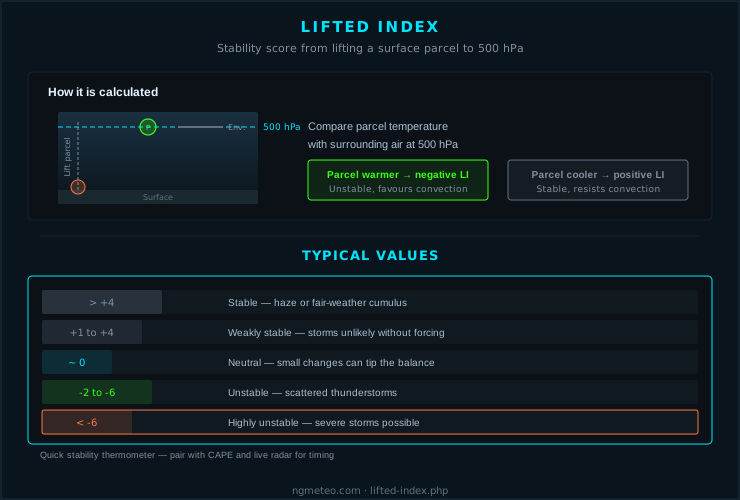
The Lifted Index is a simple stability score derived from the temperature profile of the atmosphere. Forecasters calculate it by lifting a parcel of air from near the surface to around 500 hPa and comparing its temperature with the surrounding air at that level. If the parcel ends up warmer than the environment, it is buoyant and the index is negative, favouring showers and thunderstorms. If the parcel is cooler, the index is positive and the atmosphere resists convection. On ngmeteo.com, the Lifted Index map on lifted-index.php shows these values across Europe and beyond, updated from models such as GFS and ECMWF.
Reading positive and negative values
Strongly positive values, above about +4, indicate a stable atmosphere where surface heating may produce haze or fair-weather cumulus but little deep convection. Values between +1 and +4 are weakly stable; storms are unlikely unless strong forcing arrives. Near zero, the air mass is neutral and small changes in heating or moisture can tip the balance. Negative values signal instability: roughly -2 to -6 supports scattered thunderstorms, while values below about -6 point to a highly unstable regime where severe storms are possible if moisture and wind shear cooperate. Because Lifted Index uses a fixed lifting level, it can miss elevated convection, where storms form from a warm layer above the surface while the ground remains stable.
Lifted Index and CAPE together
CAPE on cape.php answers a different question: how much energy an updraft could tap once lifting begins. A day can show moderately negative Lifted Index with modest CAPE, producing ordinary afternoon showers, or strongly negative Lifted Index with very high CAPE, a more serious setup. Conversely, high CAPE with a positive Lifted Index may mean instability aloft that surface-based storms cannot easily access until a front or gust front provides lift. Check both layers at the same forecast hour and model run. When they agree on a broad unstable zone, confidence increases that convection is possible; when they disagree, look at the wind and pressure maps on ngmeteo.com to see whether forcing along a front, sea breeze or mountain slope could resolve the ambiguity.
Using Lifted Index in planning
Lifted Index is most useful one to three days ahead for spotting air masses with thunder potential, less for pinning down exact storm locations. Animate the forecast loop: a negative index that strengthens through the afternoon confirms a classic diurnal thunder pattern, while instability that appears suddenly at night may signal elevated storms or an approaching system. Compare models; if only one run shows a pocket below -6, treat it cautiously. For outdoor events, pair Lifted Index with live radar on ngmeteo.com when the index turns negative in your region, because timing and cell movement matter as much as the stability number itself. Lifted Index is a quick stability thermometer; CAPE and radar tell you how strong and where storms may develop.