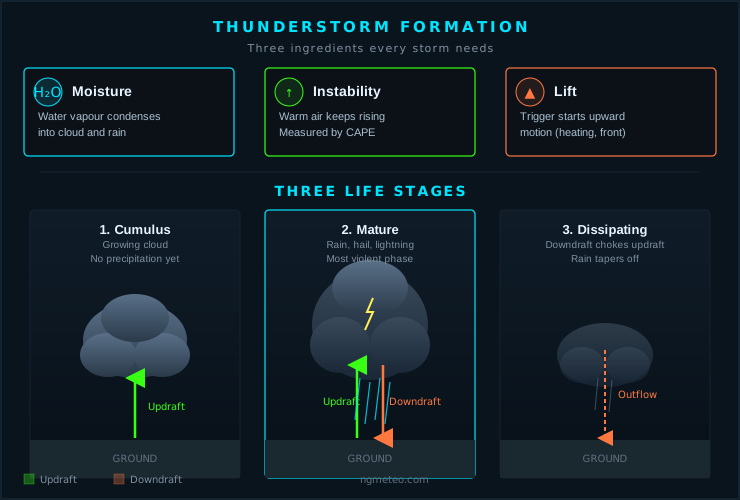
Every thunderstorm, from a brief afternoon shower to a tornado-producing supercell, needs the same three ingredients: moisture, instability and lift. Moisture supplies the water vapour that condenses into cloud and rain, releasing heat as it does so. Instability means the air near the ground is warm and buoyant enough that, once it starts rising, it keeps accelerating upward through cooler air above it rather than sinking back, a property measured directly by CAPE, convective available potential energy. Lift is simply the trigger that gets a parcel of that warm, humid air moving upward in the first place, whether that is daytime heating of the ground, a cold front shoving underneath it, converging winds, or air forced up and over a mountain range.
The three stages of a storm's life
A storm begins in the cumulus stage, when a single updraft of rising, condensing air builds a growing cloud and nothing comes down yet. As water droplets and ice crystals inside grow too heavy to stay suspended, the storm reaches its mature stage: rain or hail now falls, dragging air down with it to create a downdraft that runs alongside the still-rising updraft. This is the most violent phase, producing the heaviest rain, strongest gusts and virtually all of the lightning, which forms as ice crystals and softer ice pellets called graupel collide and exchange electric charge inside the turbulent, mixed-phase part of the cloud. Eventually the spreading downdraft undercuts and chokes off the warm, moist supply feeding the updraft, and the storm enters its dissipating stage, with rain tapering off as the whole system collapses under its own outflow.
From ordinary showers to severe supercells
An isolated, "single-cell" storm typically lives only 30 to 60 minutes, because its own downdraft kills its updraft once the two sit on top of each other. Add a bit more organisation, several cells triggering side by side or one after another, and you get a multicell cluster or a squall line, which can last for hours simply because new cells keep forming as old ones fade. The most dangerous case is the supercell, which needs one more ingredient on top of high instability: strong wind shear, meaning wind speed and direction change significantly with height. That shear tilts the storm so its updraft and downdraft no longer interfere with each other, letting the updraft persist, even start rotating into what is called a mesocyclone, for hours rather than minutes. Supercells produce most large hail, the most destructive straight-line winds and almost all strong tornadoes. This is exactly why forecasters watch CAPE and the lifted index together rather than separately: high instability with little shear tends to produce scattered, short-lived storms, while the same instability combined with strong shear is the classic recipe for severe weather. You can track both ingredients directly on the CAPE and Lifted Index maps on ngmeteo.com to see where the atmosphere is loaded for thunderstorms before they even form.